
Game preservation: emulation, recompilation and the legacy of video games
Numbers first: according to a Video Game History Foundation study published in July 2023, 87% of classic games released in the United States are not commercially available today. In practice, that means nearly 9 in 10 games in the medium’s history can only be played on old hardware, in a library, or through routes we don’t recommend. This guide explains how emulation, decompilation, recompilation and official initiatives help preserve the legacy of video games, and where the line between preservation and piracy sits.
Latest on preservation
See all stories →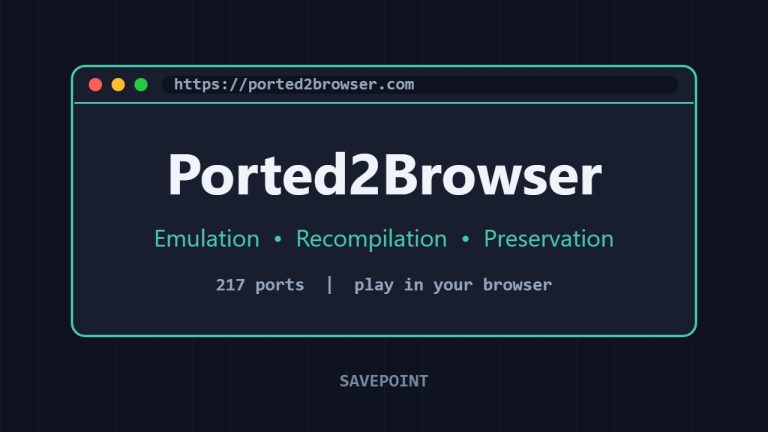
 Capitão Pixel
Guide by Doutor Overclock
Why game preservation matters
The “87% Missing” study, run by the Video Game History Foundation (VGHF) with the Software Preservation Network, looked at a random sample of 1,500 games released in the US up to 2009. The result: only 13% are still on the market. In the study’s own words, to access nearly 9 in 10 classic games there are few options: “seek out and maintain vintage collectible games and hardware, travel across the country to visit a library, or… piracy.”
Digital didn’t fix this; in some cases it made it worse. On March 27, 2023, Nintendo ended purchases on the Wii U and 3DS eShops. Existing owners can still redownload, but games that only existed there are no longer sold. Servers are even more drastic: Ubisoft shut down The Crew’s servers in 2024, and the always-online game simply stopped working. That case sparked the Stop Killing Games movement, whose European Citizens’ Initiative passed one million valid signatures.
Translated from jargon: a delisted game is history falling off the shelf.
Emulation: what it is and where the legal line sits
An emulator is a program that recreates a console or arcade board in software. The game runs “thinking” it’s on the original hardware. Projects such as MAME, Dolphin, PCSX2, DuckStation and RPCS3 are tools, but also living documentation of how those machines worked.
The legal line, in general terms: the emulator itself is usually legitimate software, built through reverse engineering without the manufacturer’s code. The most cited precedent is from the US: in 2000, in Sony Computer Entertainment v. Connectix, a federal appeals court found that the reverse engineering done to build the Virtual Game Station emulator was fair use. What is not legal is downloading ROMs, ISOs or BIOS files for games and consoles you don’t own. That’s why PCSX2, for example, tells users to dump the BIOS from their own PlayStation 2, since it is proprietary software. Emulation is not a synonym for piracy: what defines the use is where the game comes from. Laws vary from country to country, and this page is not legal advice.
Decompilation and recompilation: putting the code back in human hands
Decompiling means taking a game’s machine code and rewriting it in a readable language such as C, until recompiling it produces a file identical to the original. The best-known milestones are on the Nintendo 64: the Super Mario 64 decompilation was completed in 2019, and the Zelda Reverse Engineering Team finished Ocarina of Time in late 2021. These repositories don’t include the game’s graphics, sound or music; they contain only code rewritten by the community.
With the code available, native ports follow. Ship of Harkinian, by the Harbour Masters group, released in 2022, turns Ocarina of Time into a PC game with widescreen and high-resolution graphics, but it only works if you supply your own copy of the game. Static recompilation takes a different route: N64Recomp, created by developer Wiseguy, translates the cartridge’s code straight into C, skipping the manual decompilation step. Its first big result was Zelda64Recomp, a port of Majora’s Mask whose repository states it contains no assets and that “the original game is required” to run it.
In practice, that means a technical record that outlives the hardware. Cartridges age; documented source code, not so much.
Browser ports and official preservation
The browser has become a preservation platform thanks to WebAssembly. Ported2Browser, which we covered here, is a directory of more than 200 ports that run right in a tab, each hosted on its creator’s own site, with rights status that varies from project to project.
The GOG Preservation Program, launched in late 2024 with 100 games, commits the store to keeping classics compatible with current and future PCs, DRM-free. Nintendo Switch Online offers NES, Super Nintendo, Nintendo 64, Game Boy, Game Boy Advance and Sega Genesis libraries and, on Switch 2, GameCube. Antstream Arcade streams more than a thousand licensed retro games. And in 2025 the VGHF opened a free digital library in early access, with development documents and more than 1,500 out-of-print magazines with full-text search.
How SavePoint covers preservation
In this section you’ll find news on emulators, decompilations, recompilations, re-releases and official preservation initiatives, always sourced and written by us. The rule is simple and has no exceptions: we report on legal projects and official initiatives, and we never link ROMs, BIOS files or downloads of copyrighted material. When a project requires a copy of the game, we say so clearly. And when a classic is still on sale, the official version is the best way to support the people who made it.
Source: Video Game History Foundation, GOG, Nintendo, the projects mentioned.
Projects to follow
- RetroArch / libretro Open-source frontend that bundles dozens of emulators (libretro “cores”) in a single program.
- MAME Decades-old project that documents and emulates arcade boards and other vintage systems.
- Dolphin GameCube and Wii emulator, known for its detailed technical progress reports.
- DuckStation PlayStation (PS1) emulator focused on accuracy, performance and visual enhancements.
- PCSX2 Open-source PlayStation 2 emulator; the BIOS must be dumped from your own console.
- RPCS3 Open-source PlayStation 3 emulator and debugger.
- Xenia Open-source Xbox 360 emulation research project.
- N64Recomp Static recompilation tool that turns N64 code into C for native ports.
- Zelda64Recomp Native Majora’s Mask port built with N64Recomp; requires your copy of the original game.
- Ship of Harkinian Harbour Masters’ PC port of Ocarina of Time, based on the decompilation; requires your copy of the game.
- Video Game History Foundation Nonprofit that preserves video game history and runs a free digital library.
- GOG Preservation Program GOG program that keeps classic games compatible with modern PCs, DRM-free.
- Internet Archive Nonprofit digital library with historical collections of software, manuals and magazines.
- Ported2Browser Directory of game ports that run in the browser, each hosted on its creator’s site.