

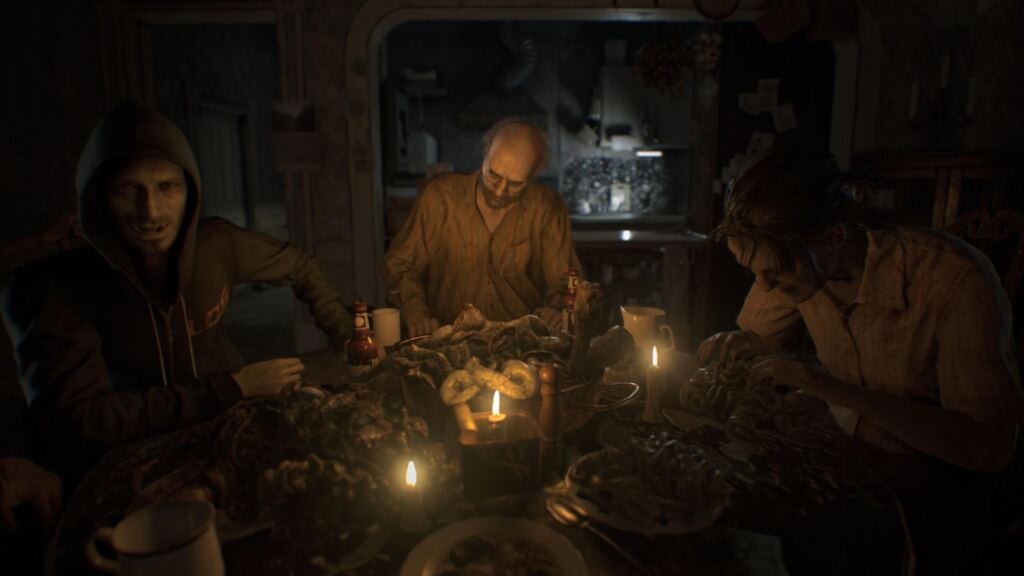
Reviewed on: Xbox One
Possibly the most controversial game in recent times, but fortunately all the controversy the title may bring will be concentrated in the gaming sphere and mainly among fans of Capcom‘s long and traditional horror and action series.
An older fan may enjoy the return to a slower pace with a tenser, suspense-filled atmosphere that became a trademark of the series in the 90s, while another old-school fan may criticize the game for straying too far from the style, even saying it’s not a “legitimate Resident Evil”. Oh, but it is! And how!
The change in perspective – from third to first person – is the main and most glaring change. A cause of apprehension for many who feared the series would take the even more frenetic action route of the traditional FPS on the market like Call of Duty and Battlefield, instead of a return to its origins, evoking suspense classics like Alone in the Dark that many had been asking for. Of course the first-person perspective is not new to the series; the more traditional player will remember the spin-off Resident Evil Survivor on the first PlayStation, which used the same kind of gameplay.
But unlike that spin-off which, by the way, was quite weak mainly due to the technical limitations of the time, RE7 puts the player in a completely new atmosphere, with some passages full of suspense and tension. It is much more a first-person adventure with lots of exploration than an action FPS. And as I said, it is indeed a true Resident Evil.
Even though many may say that, take away the title and a few references, the game could be anything other than a Resident Evil, and in some parts it really seems to have been born as a project unrelated to the series that later received some elements to make it, in fact, a Resident Evil (but there I’d be speculating), the truth is that at the beginning this impression is very strong, especially for those who tried the demo, which used only the first part of the game, which really seems quite far from everything we’ve seen over the years in the series’ games.
But little by little the elements fall into place, the references start to appear, and before we know it, we are experiencing the familiar tension and fear of facing an indestructible boss that chases us throughout the whole game. And it doesn’t stop there: we have herbs to recover health, a heart monitor to track it, the ability to combine scarce items to create new ones and chests to store them, puzzles involving paintings and clocks to open doors and clear passages. At one point you’ll be in the middle of a puzzle to swap an old, broken shotgun for a new, working one; fortunately here we don’t risk finding any “Jill sandwich” along the way, lol.
But not everything is rosy: despite very well implemented mechanics, the game has very simple and even uninspired puzzles, and the setting, although well built and immersive, could have been explored better with a greater variety of enemies and moments of tension and suspense. The story is carried along by the old cliché where everyone knows what’s going on except you, and although they keep calling you all the time, there’s never time for someone to just tell you what the hell is going on.
But while this apparent simplicity may seem negative, it is also an attraction of the game. You know what you must do, throughout the game you have a clear goal and the game gives you the tools to accomplish it, you just have to know how to explore and use what you have at hand to advance. You will hardly find yourself walking in circles with no idea where to go, and that is a very positive point of the game, although a few more jump scares would be welcome.
In this kind of game, mechanics are intrinsically tied to the setting, and in this case audiovisual factors are fundamental. And the game is quite competent in this respect: you get very dark and even oppressive scenarios, but at certain moments some flaws become very evident, like low-quality textures, the movement of some characters and even details such as hair that looks somewhat artificial and even strange.
On the other hand the sound plays its role very well; the music only appears in a more action-oriented tone when meeting enemies or in boss battles. During the rest of the game the soundtrack is practically nonexistent and you can hear your enemies walking, knowing exactly where they are coming from; there are ambient sounds and isolated sound effects that increase the tension, plus excellent voice acting work in all the characters.
The narrative, as said, is simple: you went to Dulvey in Louisiana looking for your missing wife, ended up in an old, sprawling estate infested with crazy people and monsters who want to kill you, and your goal is to escape alive. It is not a reboot, and although it has practically no connection to its predecessors, the game still takes place in the same universe, a few years after the events in Raccoon City.
Resident 7 doesn’t try to reinvent the wheel; on the contrary, it takes several features from other good games in the genre and even from movies, like Saw for example, and adds them to its own world and setting. The result is a game with some small flaws, but one that delivers quality fun, totally on par with its predecessors.
While it can be criticized for straying too far from the series’ style, the courage of its developers in doing so is also commendable. It brings back the tension and suspense of the first games, and does so by adopting an enormous change in its mechanics that, although it works very well, may not please everyone.
But hey! Didn’t Resident Evil 4 also mark a big change in the series’ style? And isn’t it acclaimed by many to this day precisely for that?
Whether Resident Evil VII will live on to become a trend and reference in the series only time – and sales – will tell, but I would like – very much – more games in this style.
- Mechanics: 9
- Audiovisual: 7
- Story: 8
Final Score: 8.0
Xbox One version
 Max Xavier

Comments (0)
Be the first to comment.