

Reviewed on: PC
It is well known that humanity is completely fascinated by stories. Since the earliest times (without Hermes and Renato, please; a Brazilian comedy group), we have used this ability to fabulate, whether to entertain ourselves or to teach us. Great stories mark us so deeply that it would be hard to explain to a non-human why this happens. Old stories, like The Iliad, Hamlet, Les Misérables and more recent stories like The Walking Dead and Game of Thrones have held and continue to hold thousands of fascinated people with their rich characters, detailed backdrops and dazzling settings.
A House with Many Doors follows this example of a narrative that grips its player, making it seem almost like a book, only playable.
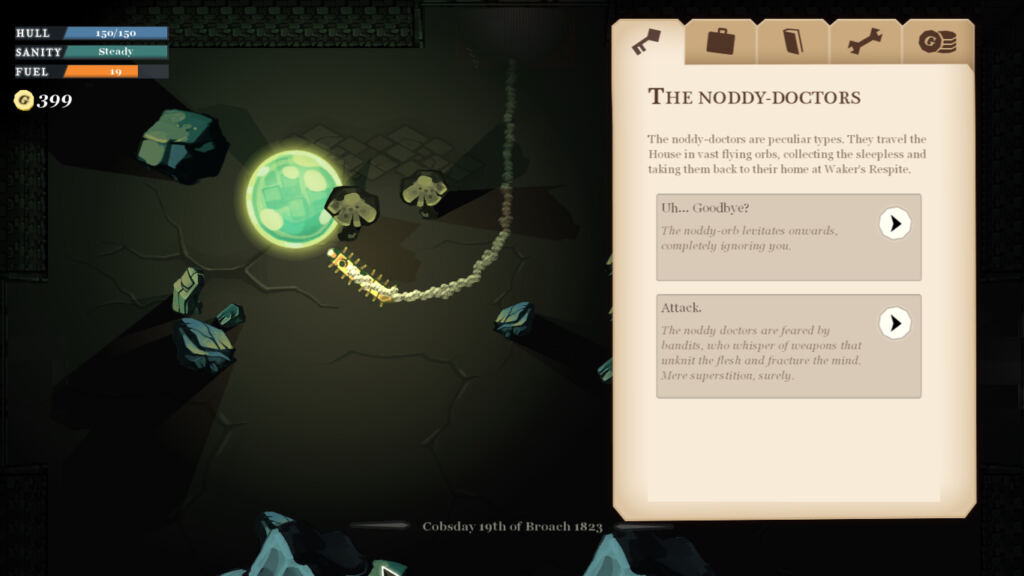
That’s the kinetopedeYou wake up in the game immediately. No prior introduction, no welcome. The text briefly sets the scene while you decide whether you want a tutorial or not in the most organic way possible. After a brief dialogue that tells you, only more or less, what you have to do and what the hell that yellow thing letting off smoke is, you can explore the House. The House is a parasitic dimension that sucks pieces of other worlds and inhabitants into itself. To explore this huge place, you use a Kinetopede ─ a robotic tank that stirs the imagination of steampunks in a way only those who appreciate this kind of setting know.
The game’s brilliance is all in its narrative. The way the game is written and told, its dialogue, the lore and the setting are very rich. Everything recalls good tabletop RPGs, where problems are solved with roleplaying and dice. It’s no different in A House with Many Doors, where several problems can be and are solved just through dialogue or with skill checks as in a tabletop RPG session. The richness of this dialogue is perhaps only eclipsed by the sumptuous setting and background of the game. A very fine mix of Steampunk with Lovecraftian Horror fills each character’s stories in a very pleasant and attractive way.
City of KnivesCharacters who, by the way, are the most human (even when they are zombies or goat-men) that I’ve seen in a game. They have distinct and very accurate personalities and traits, a reflection of this narrative revolution that A House with Many Doors sets out to be. Romances, fights, friendships and companionship, betrayal and everything you see in great fiction. In fact, the game’s own “main” plot is very interesting and grips you in an absurd way.
But A House with Many Doors is FULL of problems.
The first we can cite would be the game’s mechanical problems. The game map is ridiculously huge! A lot to explore, really, but it’s made of repetitive settings and full of unnecessarily empty spaces. Apart from the already mentioned fabulous dialogue, all you do in the game is walk through these maps and do text exploration through menus. That is really disheartening in the game.
The kinetopede combat is quite interesting at first sight. The clash can be done in two ways:
Directly, through cannon attacks, or “indirectly”, when the soldiers and guards of your crew board the rival kinetopede in full pirate style, all organized in turns, which strongly recalls an indie classic with the same approach: FTL. This system is pretty cool, has plenty of layers of strategy and can produce interesting moments, but its execution is far too superficial and very poorly explained. A prime example of this is your crew members. Each plays a fundamental role at this moment and some of them are quite obvious: Soldiers and Gunners provide the offensive capabilities, either by themselves or through your machine’s cannons; doctors heal any crew members; engineers keep all the machinery up to date and so on. But how to make them perform their roles is not explained! Understanding that the semi-transparent circle is their “range of action” and that the character just needs to be near the target of the action took quite a while. Enough for me to have to start two or three new saves and feel very frustrated.
The lack of a clear and objective graphical interface is also disheartening. The menus are confusing and the controls within them are not very clear, making it much harder to appreciate the good stories A House with Many Doors has to offer.
The audiovisuals are not superb, but they are no disaster. The game’s art direction is simple: very well-drawn art that recalls oil paintings, and the choice of colors, sounds and music, all very subtle and meaningful, contribute to the melancholic despair mood of A House with Many Doors. But in certain moments, the choice of simple art can become simplistic. During combat, your characters are represented by small drawings that strongly resemble board game meeples, with few animations that are, again, simplistic, when we have them at all.
A House with Many Doors is a book you play. With a fantastic story, interesting lore and a very well-constructed narrative, it is truly sad that all of this game’s problems and fatal errors push us straight into an abyss of boredom and frustration. A promising game, full of excellent ideas, all poorly executed.
A House with Many Doors is available on Steam.
STORY – 10
MECHANICS – 3
AUDIOVISUAL – 7
Final Score: 6.6
PC version
 Max Xavier


Comments (0)
Be the first to comment.