

Reviewed on: PC
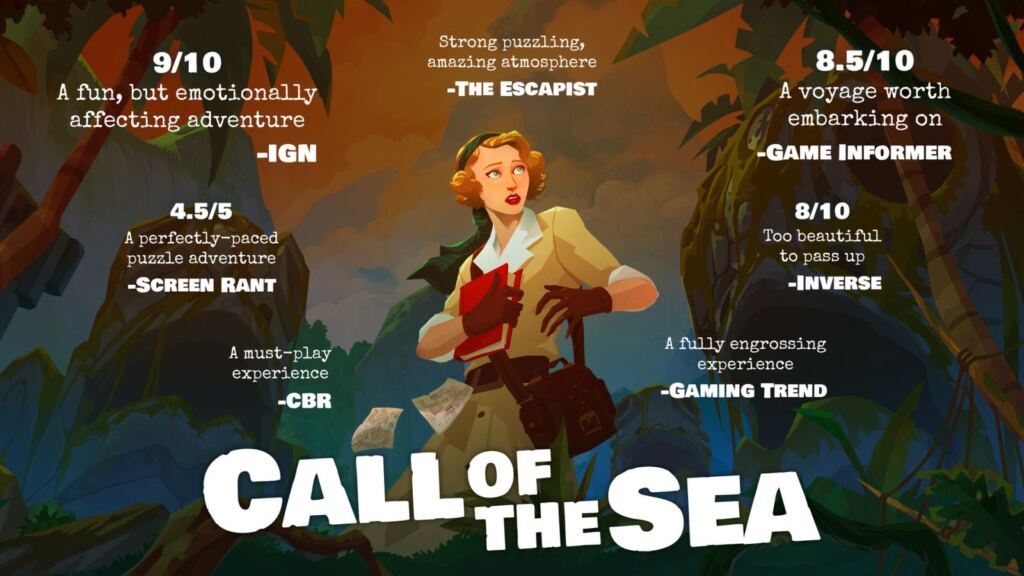
The year is 1934. Norah, our protagonist, a brave and adventurous woman, leaves her home and sets out across the Pacific Ocean in search of her husband’s missing expedition, after receiving strange clues. He had left to look for the cure to a strange illness that afflicts Norah, and apparently something went very wrong… And so, with Norah arriving at a strange island that frightens the local sailors, Call of The Sea begins, with a premise very familiar to anyone who has played, read or watched any story based on the Cthulhu mythos. Not that the game has characters known from the Lovecraftian stories, but the soul is there. But familiarity is far from a negative; quite the contrary. Call of The Sea is a game that sets out to deliver a memorable adventure and does so with a mastery rarely seen in a video game.
Call of the Sea is a first-person adventure game with puzzles and mysteries to solve, and the player makes their way by facing riddles, finding clues and uncovering more and more details of the mysteries surrounding the protagonist Norah and the other characters. As an adventure game in the mold of Myst, Call of The Sea has no combat mechanics, nor exploration like a platformer, or anything similar. You can walk, run and interact with different artifacts, mechanisms and other trinkets to make progress. And like all games of this genre, Call of The Sea depends on three pillars: a good story, a cool setting and creative, challenging puzzles. A game like this needs those three things, and I am very happy to see that, in all three areas, Call of The Sea is nothing short of excellent.
The story begins with Norah arriving by ship at an isolated island in the Pacific Ocean. Apparently, even the experienced sailors of the region don’t like to go anywhere near that island, but it is not known why. From afar you can already see a strange monument in the center of the island, very tall, but otherwise the environment is paradisiacal. Norah went to the island in search of her husband, who had set out on a trip looking for the cure to a strange illness Norah developed, which leaves her weak and creates strange marks on her skin. And it is in that skin that we play, playing Norah who, upon receiving a letter with the location of this island, a key and an odd dagger, chooses to overcome the weakness that comes from her illness and solve this mystery with her own hands.
Norah is a great character, and she is very well acted throughout the game. With each new discovery, each new area of the island explored, each new riddle solved, Norah makes comments, as if talking to herself to keep her sanity amid the island’s solitude. It is all very well done, very natural, and each of her lines is important to the story, which, although not the most original plot in the world, is developed with mastery. During the roughly five hours of play, Norah explores not only the island but also herself, going through a journey of self-discovery that does not sound false or forced, but relevant to the character. It also helps a lot that the game does not run too long, and lasts exactly as long as it should. The story is told concisely and directly, and the ending, which I will definitely not go into detail about here, wraps up the whole plot very well without leaving loose ends. Norah’s relationship with her husband is also very well developed, which is essential to the narrative.
This journey is set on a beautiful, paradisiacal island with some of the most beautiful visuals I have ever seen in a video game. Call of The Sea has a story based on the horror tales of H.P. Lovecraft, but despite that it is not a horror game. The environments are colorful and bright, and every corner of the island was made with great attention, from the beaches and forests to local villages, to an abandoned ship and ruins lost in time. The game’s look is truly a show of its own, putting you in the game world and giving that immersion so necessary for games of this genre. The soundtrack is not intrusive, and the game stays silent for a long time, but music comes in at key moments of the story or when the player solves an important mystery, and when it does it is always at the right moment. And the compositions are beautiful: one of the game’s main recurring themes, “74 Miles East”, which plays in the first moments of the first chapter, has a leitmotif (that little piece of melody that repeats across the other songs on the soundtrack, like those notes of the Imperial March that always play when Vader enters the scene) that won’t leave my head.
Each chapter of the game takes place in an area that the player must explore, and which always has a larger riddle that must be solved for the game to advance to the next chapter. In the first chapter, for example, Norah needs to cross a river, and to make that possible she needs to explore every corner of the beach for clues, going through other smaller puzzles and finally finding the final solution. Scattered through these areas are also story details and objects that give the island a stronger identity. An important point, which ties the story to the gameplay, is that Norah is on the island looking for her husband, who apparently was there some time ago. That means that, besides the mechanisms and ruins, Norah finds traces of the other expedition’s presence, such as tents, notes and objects left behind, and these things not only tell the story of what happened there before but also give hints for the riddles in a very natural way. After all, if someone passed through there before, someone already solved all of that in some way. In this way, Call of The Sea gives the player clues in a way that is fully integrated into the game.
Norah has a little notebook in which she writes, copies or draws any information that matters to the game. In this notebook, which the player can access at any time, there are two sections of notes. One relates to the story and lets the player see everything from the character’s point of view. This is a powerful narrative tool that Call of The Sea uses very well: what matters in the plot is not just the story itself, but how Norah interprets and understands it. The other part of the notes is reserved for more practical things, information about the game’s riddles and puzzles, such as codes, important images, drawings, etc. At no point during the entire game did I feel the need to write anything down on my phone or on paper, because Norah does that work for me and leaves everything easily accessible. In fact, this notebook can be opened and viewed even while interacting with an object, which means, for example, that if you are working on a complex puzzle that requires you to interact with buttons on a machine, you don’t need to keep entering and leaving that interaction; just press the button to pull out the notebook and find the information you need.
Call of The Sea’s puzzles are surprising. They are clever, creative, challenging, and the game does not usually repeat mechanics from one chapter to the next. This is the game’s strongest point, as it should be. If a puzzle in a late chapter were simply a harder version of an earlier one it would lose much of its charm, but that is not what happens here. Each new chapter of the story is not only set in an area always very distinct from the previous one but also brings themes and riddles that have everything to do with that area and with mechanics not seen before. Because of that, the game never gets tiring: at every step you discover a new and creative way of interacting with the environment around you. In fact, during the last chapters of the game, when you think you have seen it all, Call of The Sea throws even more unexpected things at you. The solutions to the riddles are all very clever, and, although some are quite hard, all the necessary hints are there.
At the end of the five hours of play, I came out of Call of The Sea extremely satisfied. With each chapter the game raises the stakes, and there is no “sag” in the narrative, which moves at a brisk pace to its conclusion. Although it is not such an original or unpredictable story, it is very well told, and if the player manages to unravel the main mystery before the final reveal, that is also to the game’s credit, which placed the right clues in the right places for the most attentive players. After finishing, I went back to each chapter to look for the secrets I hadn’t found and collect every note I had left behind, and the game has a chapter select screen that lets you easily revisit any area of the game. In addition, all of the puzzle notes Norah has in her notebook remain available when replaying a chapter, so the player does not need to re-explore what they already know, making everything easier.
Call of The Sea is simply phenomenal. A touching, personal story of discovery, told by a charismatic protagonist with great voice acting, set on a paradisiacal, beautiful and mysterious island. Mechanically flawless, without bugs or any technical problems, with the right length, clever riddles, and with graphics and a soundtrack that are works of art, Call of The Sea is a must-play game. Just as the island marks Norah’s life, Call of The Sea is a beautiful and mysterious journey that will leave its mark on every player and on the video game industry. Adventure games are not dead, and this is the new quality standard against which the next games in the genre will be compared.
 Max Xavier

Comments (0)
Be the first to comment.