

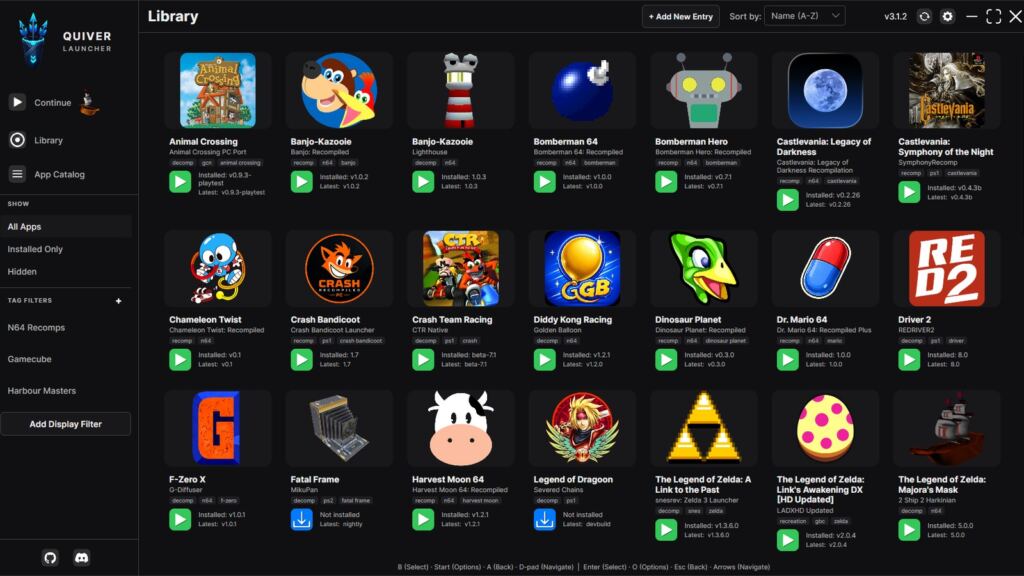
Numbers first: more than 400 projects in the catalog, four operating systems and an MIT license. Quiver Launcher is a free, open-source app that brings community-made PC ports, recompilations and recreations of classic games together in one place, including Zelda 64: Recompiled and Ship of Harkinian. In practice, it does for preservation projects what a digital storefront does for commercial games: it finds, installs, updates and launches them. With one key difference: Quiver does not sell or hand out any games.
What Quiver Launcher is
Quiver is maintained by Thomas Georgiadis (tgeorgiadis on GitHub) and started as a fork of GithubLauncher by SirDiabo, a launcher built around Nintendo 64 recompilations. Version 2.0, released on June 20, 2026, renamed the project Quiver and turned it into a general launcher for ports hosted on GitHub; version 3.0, from August 9, renamed it Quiver Launcher and added support for GitLab projects. The latest stable version is 3.5.1, released on October 15, 2026.
The app is written in .NET with the Avalonia UI framework and runs on Windows, Linux (AppImage for x64 and ARM64, plus an experimental Flatpak), Android and macOS, which the developer still describes as a work in progress.
Which projects it brings together
Since version 3.5.0, released on October 9, the catalog comes from quiverlauncher.com. It lists names anyone following the scene will recognize: Zelda 64: Recompiled, Ship of Harkinian and 2 Ship 2 Harkinian (Ocarina of Time and Majora’s Mask), Mario Kart 64: Recompiled, Star Fox 64: Recompiled, Banjo: Recompiled, Super Mario 64 Co-op DX, the Perfect Dark PC Port, Sonic 3 A.I.R. and OpenRCT2, among many others. You can filter by project type, platform, console and even AI use in development, and each entry shows player feedback: “Runs well”, “Has issues” or “Doesn’t run”.
Translating the jargon: decompilation means rebuilding a game’s source code by hand from the original program; static recompilation, as done by N64: Recompiled, automatically converts the console’s machine code into native PC code. Either way, the result runs without an emulator and adds extras such as widescreen, high frame rates and mod support. Our game preservation guide explains the differences in more detail.
Verified downloads, mods and kiosk mode
Quiver downloads each project straight from its official GitHub or GitLab releases page. For catalog apps, the launcher checks each file’s SHA-256 hash and only auto-updates to releases marked as verified: according to the 3.5.1 notes, that means the file came from the app’s usual developer, was not swapped and sat for 48 hours while being scanned on VirusTotal. Blocked releases require two confirmations. There is also mod management through Thunderstore and GameBanana, SDL3 controller support, Steam Deck compatibility and a kiosk mode for anyone building a home arcade cabinet. Yes, the game launcher has an arcade mode; nobody here is complaining.
What about the games? You need your own
This is the part that matters for legitimate preservation: Quiver does not host or distribute ROMs, ISOs or game files. It only installs each project’s program, and those projects in turn require an original copy of the game. Zelda 64: Recompiled states: “This repository and its releases do not contain game assets. The original game is required to build or run this project.” Ship of Harkinian says it “does not include any copyrighted assets” and that “you are required to provide a supported copy of the game.” In other words, you need a legally obtained copy of each game, ideally dumped from your own cartridge or disc. Keep in mind that the catalog is community-curated and each project has its own rules, so read each README before installing.
If you no longer own the cartridges, several of these Nintendo 64 classics, such as Ocarina of Time, Majora’s Mask and Mario Kart 64, are officially available through Nintendo Switch Online + Expansion Pack. It is a legal and far simpler route. Projects like Quiver show another side of the idea we covered in our piece on Ported2Browser: keeping old games playable on new machines.
Where to buy
Source: Quiver Launcher (Thomas Georgiadis).
 Doutor Overclock
 Capitão Pixel
Comments (0)
Be the first to comment.