

Reviewed on: PC
I’ve always loved RPGs. I mean tabletop RPGs: paper, pencil and dice. The number of fascinating and memorable stories created in a tabletop RPG session is incredible and unbelievable (a more-than-necessary redundancy), sometimes able to rival the great stories told in other media.
But it makes you think how heavy the life of a medieval fantasy adventurer is, doesn’t it? Living adrift, traveling roads, facing the most terrible creatures, saving worlds. Wallowing in dungeons and natural labyrinths in search of glory, treasure and fame. Darkest Dungeon rests precisely on this question and weaves a hypothesis, a “maybe”, of how stressful this kind of life would be and how that price would be charged.
The game is already a year old (a little more, actually) since its release.
The atmosphere of anxiety, suspense and panic is so strong when you play Darkest Dungeon that it becomes tactile, palpable. Starting with the story, which drinks straight from Lovecraftian horror tales: a nobleman, bored with his luxurious and lavish life, discovers an ancient legend about the gigantic estate where the opulent mansion rests. Spending every effort and all his money on the endeavor to find this legend, something terrible happens. What happened to the Nobleman and what was found will be discovered by you, a distant relative and sole heir to the whole thing. You see, you, the player, are not a character: you are the one who controls the whole game from outside (we’ll get to that) and commands the decisions about what happens and doesn’t happen on the family’s ancient estate.
As you weave through these dungeons, your characters discover old diary pages that drip by drip tell more about what happened in each of the places visited and what happened to the place in general. Still keeping the drip-feed formula, small snippets of a monologue narrated by the “missing nobleman”, like diary entries, when a boss or new enemy is found, give small insights into the story. Although narratives like these can be more appealing to some, they may put others off. The story itself is even surprising and good, but nothing beyond that. For this kind of game, a more direct narrative might have been the better choice.
The artistic side of Darkest Dungeon, quite dark and somber (pardon the antithesis, it’s clear), recalls the desperate mood set by the game’s setting and narrative. I said it before, but it’s worth saying again: Lovecraftian terror, the kind where you know nothing will be the same again and nothing will be good from then on, is brilliantly reflected in the visual choices for the characters and in the game’s soundtrack. The characters’ sprites, all with black, dense and somber outlines, mark an incredible (and deliberate?) propensity for things not working out. Disturbing at times, Darkest Dungeon puts you face to face with creatures that shatter your whole notion of the word “monster” and unoriginal settings revisited in very interesting ways. If you don’t like pigs, you’d better prepare yourself.
Darkest Dungeon, as soon as it starts, gives you a warning: “(…) is a game about making the best of the worst situations”. Believe me, by agreeing to play Darkest Dungeon, you will be getting into the most deliciously difficult and unfair RPG you have ever played in your life. There are two very distinct moments in Darkest Dungeon and, although distinct, they are cyclical and complement each other. The first is the base maintenance phase. A shallower moment, and perhaps developed in a simple way, it is in this phase that, with the resources collected on forays into the labyrinths, you will improve your facilities and organize your adventurers in general.
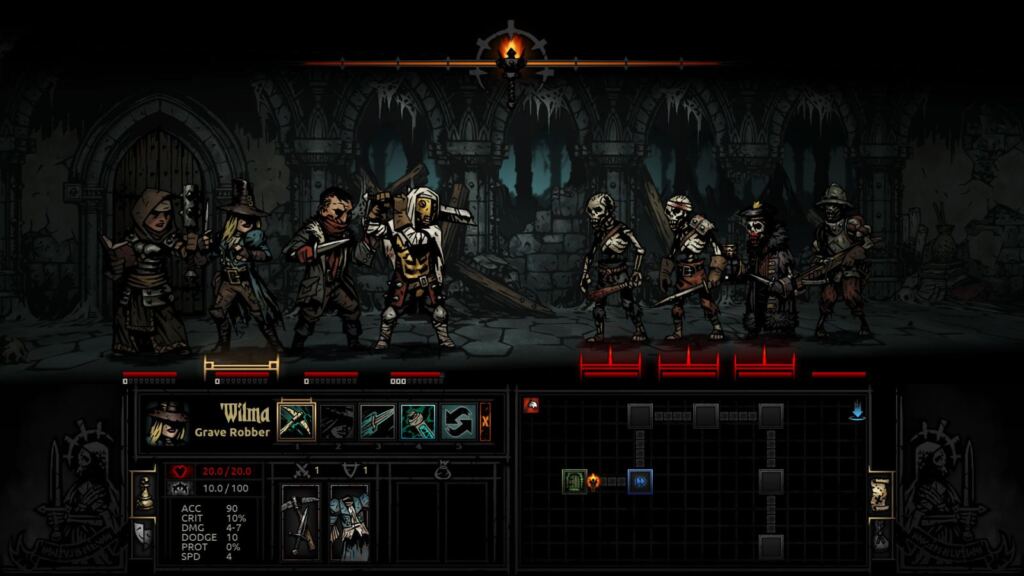
The second moment, the most important, is dungeon exploration. In sidescrolling, your party holds up to four members from sixteen different character classes. Although many of them are revisions of established classes of the genre, such as the Crusader (a paladin, or close to it) and the Vestal (a cleric), some original classes stand out a lot, like the Abomination, a kind of half-monster. With the party, you explore several completely procedural labyrinths, with various dangers, monsters and curiosities, which can sometimes be tedious and very repetitive. Combat is turn-based and character positioning is extremely important, since attacks have a fixed range that varies from attack to attack.
So far it seems like a pretty ordinary game, right?
Abandon all hope…
Darkest Dungeon is far from “ordinary”. The game’s affliction system is an ode to the English horror writer, recalling several board games based on Call of Cthulhu: as your character explores and interacts (or, put plainly, gets wrecked) in the labyrinths, they accumulate stress levels. When a certain value is reached, your character is struck by some affliction: they can become hysterical, manic, depressed, abusive, among several other afflictions, each with its own dialogue and effects! Even if you’re lucky and your possible affliction is reversed at a virtue moment, with positive effects, you can’t count on that happening, making stress an extremely important resource to manage, along with the traditional HP. Of course some characters have ways to recover stress (pretty weak ones, mind you) and, on longer missions, you can camp in the dungeons (which, by the way, is almost a minigame in itself), but even so, stress is at times more vital than HP itself.
Camping helps!The game has permadeath: your characters, if they die, are dead forever. This creates some difficulty for newcomers, who even in Radiant mode (something like an Easy mode, pero no mucho) will run into difficulties, sometimes unfair ones, like the quirks (small positive and negative traits) your characters acquire at the end of each expedition. It’s totally random and the only control you have over them is removing the bad ones and locking in the good ones. There could have been a more interesting and fun way to add these elements.
By the way, Red Hook, the game’s developer and publisher, deserves congratulations for the support given to the game. A little over a year after release, Darkest Dungeon keeps receiving frequent updates and, later this year, will get an expansion: The Crimson Court, which will already bring a new hero
Darkest Dungeon is a game you should steer clear of if you are too (badly) used to the conveniences the industry imposes today. Darkest Dungeon is, as the title suggests, cruel, dark and very unforgiving. The game will leave you at the mercy of misery and the tension of losing characters you have invested time, money (and love) in the whole time. But if you have a hardcore (and masochistic) streak, love RPGs with a more classic feel and like the Lovecraftian mood, you will love it.
STORY – 8.5
AUDIOVISUAL – 9.0
MECHANICS – 9.5
FINAL SCORE – 9
Review done with a code provided by Red Hook.
PC version
 Max Xavier

Comments (0)
Be the first to comment.