

Reviewed on: PC
XCOM and Battlestar Galactica had a baby!
Ancient Frontier is a game with Space Opera overtones in which you, the commander of a frigate of spaceships, will explore space while defending the interests of two factions with distinct histories. It is a competent SRPG, with occasional flaws that are quite bothersome.
In a few words: it’s as if XCOM and Battlestar Galactica had a baby, but one that was born a bit ugly.
When it comes to strategy games with RPG elements, the main factor to take into account is what I like to call “layers of gameplay”: the strategy variants these games have. Disgaea, for example, a classic Japanese SRPG, adds these layers in combat with options like throwing your characters across the battlefield, in addition to base and character management; Final Fantasy Tactics, in turn, adds it in the management of your roster of warriors and, more specifically, in customizing them.
Ancient Frontier does this in a very interesting way, blending typical elements of strategy games and RPGs, but adding a competent – although basic – resource management system, moving away from the basic “money” we normally see. These resources are used in many different ways: upgrades and improvements for the ships in your frigate (which are divided into four categories), buying other ships and even making use of the ships, and they are obtained as mission rewards or even from game maps, scattered around, simply by moving a unit over them.
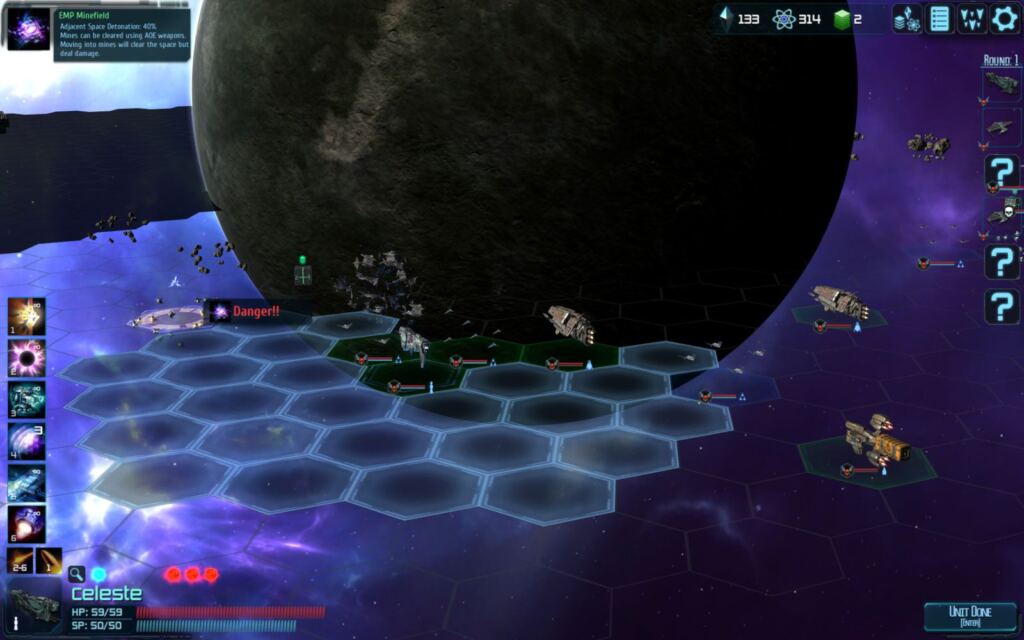
As for the game itself, it is an SRPG with hexagonal movement through space. You move your ships across space fields and, if other ships are within your range, you can carry out attacks: larger ships move less and attack more; smaller ships move more and attack less. The game also adds the famous layers of strategy by offering a good range of equipment, weapons and gadgets for customizing and improving the frigate’s members and, rarely, will one ship (and playthrough) be like another.
The game’s story itself isn’t so shallow and is very well built. All of it is backed by quite interesting lore (which can be accessed at any time in the main menu), some interesting dialogue and a fairly concise narrative, but the voice acting… Wow. The voice acting is wretched. The actors’ effort to convey the game characters’ feelings is noticeable, but the impression left is of listening to erotic audio, so great is the amount of Mise-en-scène, whispers and velvety voices. Visually speaking, the game is OK. It isn’t a masterpiece of memorable graphics, but it is quite competent and delivers cool, even well-detailed visuals. The ship models are credible and believable and I confess I found myself several times hypnotized by the battle landscapes: they are gorgeous, very well colored (and animated too, as in the case of ion storms). The artwork is also very well done, with more realistic lines on the characters. Another positive point is the soundtrack, which conveys the game’s mood well and is well composed.
But things start to get complicated from there. Because, despite the (good) ambition of being a deep game, Ancient Frontier falls short by being too shallow mechanically, narratively and audiovisually.
The game is somewhat tedious. Combat is too shallow, without much strategic depth. A scout ship (of the Wing class, the smallest) is as capable of facing a Fighter (small ships, but with good combat capacity), something rather illogical, according to the game’s own characteristics, for example. Especially in a game with an “final frontier” theme, combat needed more excitement; it needed a sense of tension. Even camera moves to show an opponent’s destruction (like XCOM’s alternate cameras, for example) are kind of meh.
Even with the “permadeath” of the ships you buy, upgrades are done generally, that is, per ship class, and not per ship. The upgrades themselves are another example of the game’s superficiality: they are simple and don’t deliver anything “wow” that surprises you. The feeling is that you are playing only to gain more “levels” and there is no concrete reason to buy the upgrades other than raising stats. And although it follows a well-established cover mechanic – in this game presented by space stations and asteroids (which can be destroyed to cause damage, and that’s pretty cool) — to protect yourself from shots. It isn’t something that gets in the way, but the option to show the grids even when we aren’t moving ships and/or attacking would be welcome.
I still don’t understand the reason for the exploration missions: you need to move your units across the map and “discover” the grids covered by fog of war (black grids), without dying (obviously). Of course the “argument” is understandable, but the applicability of this is downright silly, to say the least. A mission that consists of simply moving around the map is a waste of potential at a worrying level.
The game’s whole navigation is done through simple and, in a way, simplified menus, with no major problems. The interface isn’t confusing and is quite intuitive. But this, unfortunately, adds to the feeling of lack of depth the game gives from the start.
Ancient Frontier is a game that could have been more. It based itself on classic elements of the strategy/SRPG genre and added a different twist – the Space Opera move – but fails to bring this in a way that hooks the player, delivering a shallow and somewhat tedious game, at least at first sight. The complete opposite is expected, especially considering the theme addressed. Overall, it isn’t a bad game, it just isn’t a good game.
MECHANICS – 7
AUDIOVISUAL – 7
NARRATIVE – 6
TOTAL – 6.6
PC version
 Max Xavier

Comments (0)
Be the first to comment.