

Reviewed on: Xbox One
“You must see everything, hear everything, and then forget everything.”
The Council is a narrative-focused adventure like the ones we have seen in large numbers in recent years, largely thanks to studio Telltale, which specialized in the style and has been releasing many titles acclaimed by the public and critics. The Council embraces this trend and expands it. Imagine narrative-focused gameplay mixed with classic RPG elements and you will have an idea of what to expect in this first episode of this promising series from the folks at Big Bad Wolf Studios.
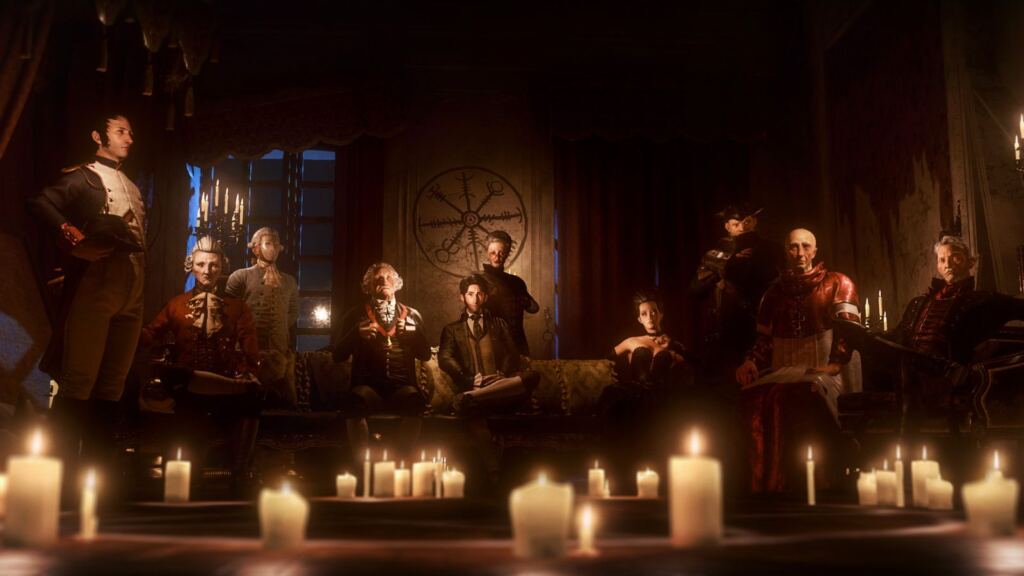
You are Louis De Richet, son of Sarah De Richet, a prominent lady of the 18th-century French upper class and leader of a secret society called The Golden Order. While investigating a case in a huge mansion located on an island off the coast of England, Sarah goes missing and it falls to Louis to uncover his mother’s whereabouts.
The mansion belongs to the mysterious aristocrat Lord Mortimer, who organizes parties to welcome a select group of powerful people from all over the world. You will meet some notable historical figures such as George Washington and Napoleon Bonaparte and countless references to real historical people, places and events as you advance in the plot. This is the feature that may hook even players who don’t much like the style; you will find references even to our country, Brazil, and to Tiradentes.
And this is very important, in a game that relies almost entirely on its story: an engaging plot with many mysteries and twists is essential to hold the player with the controller in hand for as long as possible, and The Council seems to achieve that, with a robust and well-built script. It has some flaws here and there, some rather strange or even silly dialogue, but still the mystery behind Sarah De Richet‘s disappearance will likely intrigue most players who venture into Lord Mortimer‘s sumptuous and gigantic mansion.
As said earlier the game mixes some RPG elements and this contributes a lot to making its gameplay more engaging and interesting. At the start you will be introduced to three classes: detective, diplomat and occultist. Each of them will give you skills that can and should be used to obtain information and clues during your journey. For example, an occultist finds it easier to understand other languages, a diplomat knows how to induce a person to give more clues during a conversation, and the detective can perceive small nuances of behavior that may indicate when a person is lying.
This will be very useful in the confrontation events (Confrontation events), The Council‘s equivalent of a boss battle or Quick Time Event in other games, with attacks and defenses and use of energy points, all adapted to a conversation between characters. During these confrontations the player must use various persuasion techniques to obtain information and, for that, will use the so-called Effort Points, which are spent when using skills of the character’s class. These points can be expanded and recharged during the game through consumable items. It seems complicated at first but believe me, it soon becomes quite natural and easy to understand.
Another interesting feature of the game is that the NPCs you will talk to also have their strengths and weaknesses, in some cases being immune to certain techniques while vulnerable to others. All of this gives the gameplay great dynamism, not to mention that the game does not hold the player’s hand at almost any point except for the tutorial instructions; if you say what you shouldn’t or use up all your effort points, you must restart the whole confrontation until you manage to obtain the information or items needed to advance the story.
Another interesting point is that our choices during the game – and that includes the class we give our character – directly affect how the story unfolds. Going to different places or talking to different people can change the entire course of the plot and lead us to new clues or even new environments. These choices are permanent; there is no way to go back and see what would have happened if we had chosen another option, other than starting over from scratch. But believe me, if you enjoy the story of The Council, you will certainly start a new game, not least because this first episode won’t take you more than about two hours, so the replay factor ends up being high.
Not everything, however, works out satisfactorily. If on one hand the story can hook the more dedicated player, the same cannot be said of the graphics. Nothing regarding the environments, since the settings are beautiful, spacious, very detailed and invite the player to explore them in minute detail. The character models, on the other hand, could have received a little more care – they are even quite well made, but with some rather strange facial and body expressions. This takes some of the shine off certain scenes, especially with facial close-ups. The voice acting is also not among the most impressive, has its ups and downs, but manages to hold up. Sound is present in few moments, mainly in cutscenes or confrontations, but only serves to set a mood without influencing the gameplay that much.
The Council certainly has what it takes to please a good number of players and make them dive headfirst into its mysteries and twists. With a few small technical flaws, the project, planned to have five chapters, is very promising and highly ambitious; it remains to be seen whether it will manage to keep its pace and fix its flaws in the coming chapters.
- Mechanics – 9
- Audio and visuals – 6
- Story – 9
Final score – 8
Played and reviewed on Xbox One
 Max Xavier
Comments (0)
Be the first to comment.