

Reviewed on: PC
RPG to the core.
RPGs are a really cool game. I’m talking about the pen-and-paper kind: dice and pencils on the table. Characters being role-played, adventures, treasure and, most importantly: Possibilities. While in electronic RPGs we’re stuck with a main quest (even if the game lets us comfortably flip off the main quest – like Skyrim), it’s unchangeable that your choices generally don’t make a big difference. Divinity: Original Sin II relies precisely on the opposite.
Possibilities and Freedom. Pay attention to that.
The premise – which, frankly, is super simple – serves only as a backdrop: you are a sourcerer, a kind of mage extremely frowned upon by society since your magic is capable of attracting abyssal beings – the voidwoken – who bring chaos, mayhem and destruction wherever they go. To prevent this, most Sourcerers have their powers nullified through a special shackle and are taken to a prison on a distant island. Your adventure begins on the ship carrying many of these sourcerers to Fort Joy, the prison mentioned.
And it’s an adventure for real, because Divinity: Original Sin II takes the RP of its RPG seriously. Every choice, whether inside or outside combat, has weight and consequence – even if in the very short term.
Light spoilers ahead:
As soon as you arrive at Fort Joy, you come across your first main quest: escape from there. From this moment on, related quests appear (or not) for you and, deep down, you choose how you’ll do it. One of the things that instantly captivated me about this game happened right after.
Another sourcerer said he had two pairs of magic gloves capable of teleporting another person. One of the pairs is with them, but some crocodiles (!!!) supposedly ate the other pair. So, he says that if we recover the other pair, we could escape through a path he had found earlier. I accepted the fight. Hard and fiercely, I beat the crocodiles and found the gloves. Then, I talked to the man and he guided me along the hidden path and showed me how we’d do the puzzle of teleporting one another in succession until we escaped the island.
Except I didn’t do that.
By pure accident, I ended up teleporting him to the wrong place and killing him. There went my chance, at least with the extra pair of gloves. And that was how I dealt with it. Because you could simply not have gone to the crocodiles or, you could have gone, with a team assembled, defeated them, kept the glove and simply ignored the guy’s request.
Your choices, again, matter in Divinity: Original Sin II ─ races, gender and even specific characters influence choices, dialogue lines and interactions between characters ─ and, above all, you have TOTAL freedom to make them. In Fort Joy alone, I counted – without any exaggeration – ten different ways to escape the place. By the way, Fort Joy is only the first part of the first act of the game. And I spent, in this first part, a modest FOUR HOURS to finish – and I finished the first act in 12 hours. ONLY THE FIRST ACT. The narrative aspect of Divinity: Original Sin II is all interwoven and complex, with dialogue that at times borders on the absurd, at times is hilarious (if your character can talk to animals, get ready for the funniest dialogue possible) and all of it has a purpose and a chance of changing the questline being carried out, however slightly. The chained dragon can easily be executed, since it doesn’t react and it has lots of treasure… but freeing it could turn it into a powerful ally. Or not.
Again: Possibilities and Freedom. Get ready for MANY hours of gameplay. Really many.
Divinity: Original Sin II is a very beautiful game, even being a tactical, isometric RPG. It’s not a graphical marvel that will leave you open-mouthed like the greatest revolution that ever existed, but it is extremely beautiful. The complexity of the races, the customization possibilities, besides the atmospheric soundtrack, give the audiovisuals an epic and magical air, which fits the game’s proposal well. But it’s in the mechanical aspect that Divinity: Original Sin II stands out and cancels out any aesthetic and functional ugliness ─ like the confusing menus and the item management that could be a little better.
Barrel of water on fire: Smoke cloud!The game has a very impressive mechanic of interactivity with the environment and reaction to everything you do. Use a healing spell on an injured NPC and he’ll heal you, sell items or even show up in another battle to help you; use a spell or item that spreads oil across the surface and set it on fire. If you use a water spell (or a simple bucket of water) on the fire, you raise smoke – which camouflages you from enemies thanks to poor visibility; water and blood can be frozen or electrified, and so on. Mastering this factor makes all the difference in the game. Entire battles can be won or lost through sheer lack of attention to this detail. And, as a strategy game through and through, Divinity: Original Sin II is quite cruel with its difficulty, even on the lowest levels. Don’t think this is Disgaea or Final Fantasy Tactics where battles can be won purely with attribute stats and the tactical aspect ends up taking a back seat. All the movement and positioning of your characters makes an enormous difference. For example: an archer deals more damage when on higher ground; trapping an enemy in a “pincer” formation gives you advantages. A specific talent for mages makes their spells cost less when they are on a surface matching the element to be used. Backstabbing.
How you handle the combats is entirely up to you. Whether striking first, or being taken by surprise.
Divinity: Original Sin 2 – Definitive EditionOnce more: Possibility and Freedom.
And, if we add the elemental surfaces mechanic, we have a game that instantly reminded me of many D&D and Mage Knight tables I played. The spells are really cool – especially the necromantic and mutagenic ones, which are a show of utility and brokenness.
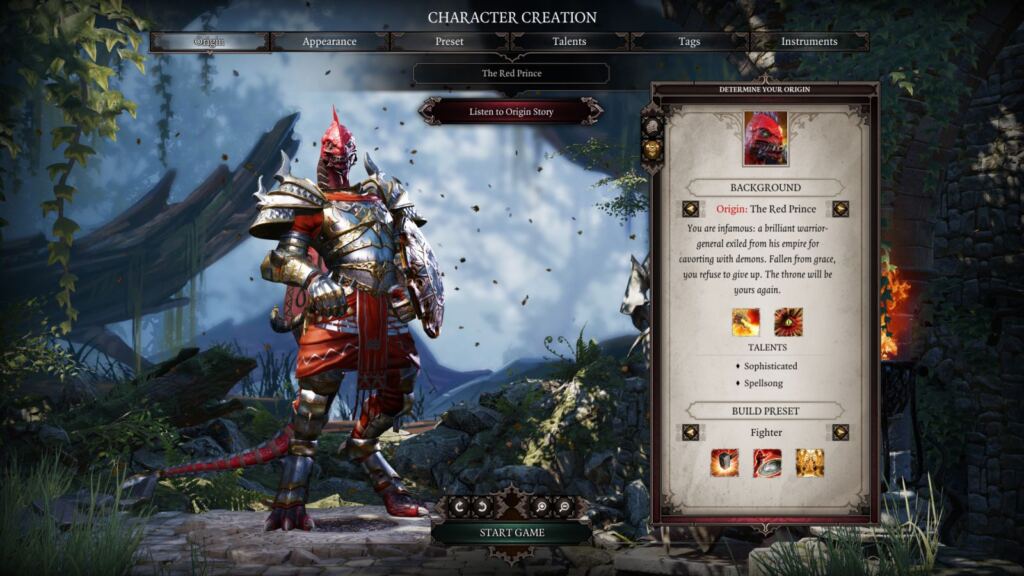
And don’t think that just because you must choose a class in character creation you are stuck with it. That, as in Dark Souls for example, is only the initial guideline. How you build your characters is entirely up to you. Want a mage who smashes with a dual axe? You can. Want an Archer who summons allies and teleports to high places? You can too. A sneaky rogue who settles things more with talk and less with fists? Also possible. Your character’s “sheet” is quite complex and the game offers many abilities – combat or not – to color a world that is extremely rich in lore and… once again: Possibilities and Freedom.
Divinity: Original Sin II is a game that has to be savored calmly. There’s no use rushing or trying to solve everything by brute force, but nothing stops you from solving everything that way if you want. As in a tabletop RPG, sometimes the way out is in an item, a line of dialogue or non-combat skills. The most important thing is: how you make your way is a choice, entirely yours.
Sure, a few bugs, the weak item management, the somewhat confusing menus and the framerate that sometimes suffers may leave you slightly annoyed, but it is a minimal dimming of such an incandescent star. Divinity: Original Sin II is a masterpiece of Western RPGs and some JRPGs could learn about Role Playing from this game.
Masterpiece.
SCORES:
Mechanics – 10
Narrative – 10
Audiovisual – 10
 Max Xavier

Comments (0)
Be the first to comment.