

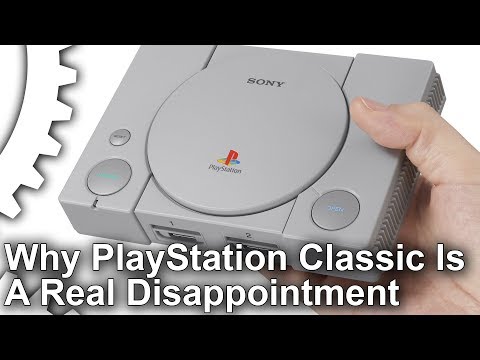
Sony recently announced a commemorative edition of its famous PlayStation 1 (PSX). The PlayStation Classic was announced to please the brand’s longtime fans, bringing a scaled-down copy of the original PlayStation with a game library already stored in the console’s memory. Basically, a nostalgic product was expected, where it would be possible to replay the console’s great classics with improved quality (through filters and adjustments to improve video output) on current TVs.
Unfortunately that is not what Sony delivered, starting with the limited library, with very few classic games… Beyond that, we also learned that the library is fixed, meaning Sony will not add games later to the limited 16GB internal memory. Digital Foundry, which recently analyzed the console, said:
“The PlayStation 2 includes both the hardware and the software needed to play original PS1 games at native resolution, while introducing optional enhancements, such as faster loading and texture smoothing. The PSP, Sony’s first handheld game console, also received PS1 game support in 2006, and thanks to the shared MIPS CPU architecture, only partial emulation is required – many of the instructions can run natively on the PSP’s processor – a feature the Vita would later use to run PlayStation software. Even the PS3 received full support for PlayStation games with a decent software emulator.
The standard is set, with the expectation of excellent, accurate emulation support – a level the Classic, unfortunately, cannot reach. In fact, I would say this is the worst console hardware Sony has ever released, and it is a real shame because, on the surface, it looks like a great piece of technology. This new unit consists of a replica of the original design with three fully functional buttons and a controller also identical to the original, not a DualShock. In terms of software, the 20 games featured on the system sparked a lot of debate about what should be included in the PlayStation Classic and, certainly, many games I’d like to see are missing, but I feel it is still an interesting collection and most of the titles are worthy inclusions.
Inside, the Classic differs greatly from the original hardware, as you’d expect. The system is powered by a Media-on-chip paired with an entry-level ARM Cortex A35 and an integrated PowerVR GE8300 GPU, 1 GB of DDR3 memory and 16 GB of flash storage. This setup is far ahead of the original PlayStation and should offer more than enough power to emulate the original console with ease. The problem is that it doesn’t.
From the moment you power the unit on for the first time, its limitations start to become evident – although I must admit the front-end is quite attractive. The home screen features the familiar PlayStation startup sound, followed by a menu based on the original memory card / CD player included in the first PlayStation models. A game carousel adorns the center of the screen – but then you enter the settings menu and realize that, basically, there is nothing to adjust. To begin with, the PS Classic is limited to 720p output. It has no filters, scanlines or adjustments to improve video output and is locked to a full-range RGB – yes, if you are using the Classic in a limited RGB setup, you will have to adjust the display to use the appropriate setting, something that can be a nuisance if you are using limited RGB with other devices.
When you start a game for the first time, the display problems are immediately evident. The picture quality is noticeably blurry as a result of poor scaling and heavy filtering. Pixel-art games, like Rayman, should appear sharp and clean, but are reduced to a blurry mess. The emulator is configured to use some kind of MDEC filtering, resulting in less dotted and pixelated playback – something that could be considered positive, but most games end up looking murky. When you combine this with the typically blurry upscaling of 720p content that you get on most modern flat-screen TVs, the result is a lower image quality that does not do the game collection any favors.”
Below you can check the full video analysis (video in English):
Text analysis (European Portuguese): Eurogamer
 Sapo
 Max Xavier
 SavePoint Team
Comments (0)
Be the first to comment.