

Reviewed on: PC
By Anderson do Patrocínio
It is undeniable that today video games enjoy a popularity never seen before – in fact, I would risk saying this is their best moment. T-shirts in department stores and giveaways at fast-food chains put the subject into everyday conversation, along with the great wave of nostalgia for the 80s and 90s, a phenomenon that seems to have no end and that also reaches other media, but in video games finds a comfortable shelter in icons and aesthetics quite representative of those decades.
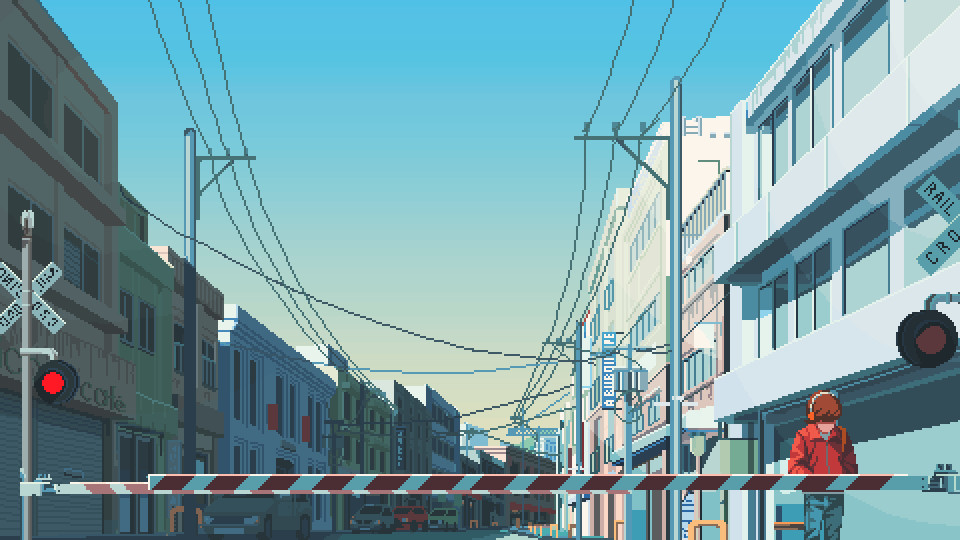
And amid all this we have 198X, a game conceived in an episodic way and whose first act was just released by Hi-Bit Studios for PS4 and PC (soon for other platforms), using the above conventions to build a nostalgic narrative about adolescence and video games.
Follow our review and better understand what this curious work is about.
Following a strong trend in indie games, 198X was announced by its creators as a narrative-focused game. It is a story set in Suburbia, a remote district of a big city in the 80s where the protagonist lives, generically presented as “Kid”.
Like every teenager wrapped up in video games, Kid goes beyond what games are as a product and sees them as a truly immersive experience, and it is from this premise that we get the structure and gameplay of 198X; each level corresponds to a game that Kid is playing, going through genres very common at the time, such as racing, beat’em up (street brawler) and shoot’em up (spaceship shooter). Basically, it is a retro collection that uses metalanguage as a narrative tool.
While 198X lets us experience gameplay faithful to each of the genres, the protagonist’s emotional experiences gain space in very well made cutscenes. Overall it is a very beautiful game, designed to fill the eyes of lovers of 90s-style pixel art.
The sound design is merely competent; some narrated passages set the tone of Kid’s personality while the synthwave genre forms a pleasant, though not memorable, sound layer. Within each of the genres the sound fits in rather well, although it is never really a highlight.
Both the graphic beauty and the good application of the sounds form the essential set for the player’s experience, since the nostalgic appeal of that era is tied not only to what games were like, but also to how they looked or intended to look.
If you have been interested so far, know that there are limits to the reach of 198X’s intentions. The game is extremely short and in saying so, I estimate that in 40 minutes an average player can reach its conclusion; and then another problem arises: basically, there is no conclusion.
It is clear that 198X’s greatest appeal is based on the emotional bond of its target audience with video games, however, each of the levels is extremely short and when you get to the point of being hooked by that proposal, the experience is interrupted by the protagonist’s reflections, and the problem here is precisely that: there is a split between the ecstasy the central character experiences as part of that narrative world and his frustration as a player at having an experience that was interrupted or did not reach its climax within that genre. All of this breaks immersion in an irrecoverable way, clouding the basic proposal of remembering past games from our childhood or rebuilding that affection with 198X’s own games.
In the end, players in their 30s may well be hooked by Hi-Bit Studios’ initial proposal, but finishing this episode will not make them feel special; it is a beautiful, nostalgic, bland experience.
 Max Xavier


Comments (0)
Be the first to comment.