

Reviewed on: PC
Metroidvania with a singular art style, Vigil: The Longest Night is, at the very least, interesting.
Vigil The Longest Night, developed by newcomer Glass Heart Games and published by Neon Doctrine, follows the wave of Metroidvania-genre games that seek to please the orphans of the Castlevania series with their own ideas.
Plot
The story behind the game’s development is presented in small portions, a patchwork quilt stitched together from what the NPCs reveal about what they know or have heard during the progress of the character, Leila, on her mission, which is to investigate and fight the dark, shadowy creatures that seem to be infesting the lands around her hometown.
The plot is not too dense and only seeks to illustrate the brief motivations that make each of the numerous missions (which have us going, and coming back, and going again, and coming back again) make some sense. It is usually the rule for platformer games to leave the story in the background, but progress becomes somewhat limited if the player’s attention does not turn to deciphering what is written in the protagonist’s notebook, which plays the role of a quest guide, but not always with very precise directions for the next step, which will inevitably leave the player not knowing what to do.
Otherwise, the influences regarding the type of horror the game tries to present are quite clear and familiar, but presented in its own way.
Graphics
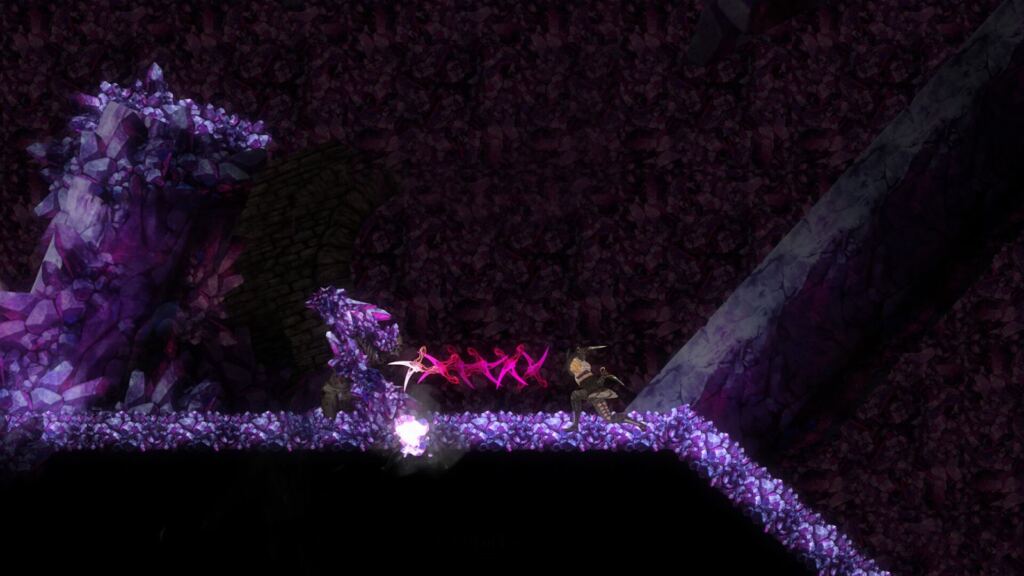
Vigil The Longest Night has an art style that renders each of its elements as if it were a painting, enriching the depth of the scenery and the beauty of its elements without an exaggerated concern for realism. This element makes the way the movements and the look of scenery and objects can be displayed versatile and also highlights how sinister the appearances of the haunts we face can be.
The way the battles against larger creatures or bosses were set up seems to have been taken from the memory of a dark tale or folk legend that grew more sinister over the generations, like Baba Yaga.
The soundtrack fits the settings well and some tracks are really good, but the game’s tone often leaves them in the background to avoid breaking immersion.
Gameplay
Leila can walk, jump, roll, attack quickly, attack heavily, use items, grab ledges, defend herself and use a series of moves that can be learned in the different skill trees depending on the combat style the player chooses for themselves.
The title brings a series of RPG elements, including character progression, experience points, levels, skill points, skill trees, equipment and the whole package.
The controversial point is the fact that it is yet another title that invests in the attempt to be the “2D Dark Souls”, where the presence of any difficulty becomes synonymous with “hardcore” challenge instead of part of the narrative (I talk more about the subject in other reviews, such as Death’s Door).
Personally, the variety of combat styles is charming, and how each of them has its own line of evolution, which lets the player choose how to face the game’s various types of enemies and develop their own combat style by mixing the possibilities.
Conclusion
Glass Heart Games’ effort is not in vain, its debut title has very interesting points and, judging by the flow of the genre in the games market, it is visible how starved fans are for good titles of this kind.
This is not the title those fans are waiting for, the one that will revolutionize the mechanics and bring an experience as polished and satisfying as its influences.
Although it still needs some polish, it has very well programmed controls and can plow the land for a stupendous title in an expansion or sequel, and for that reason it is recommended for fans of the genre.
Vigil The Longest Night is available for PC and Nintendo Switch.
Played on PC (Ryzen 7 3800X, RX 480) with an Xbox One Controller.
 Max Xavier


Comments (0)
Be the first to comment.